Ratboys Are Playing the Long Game
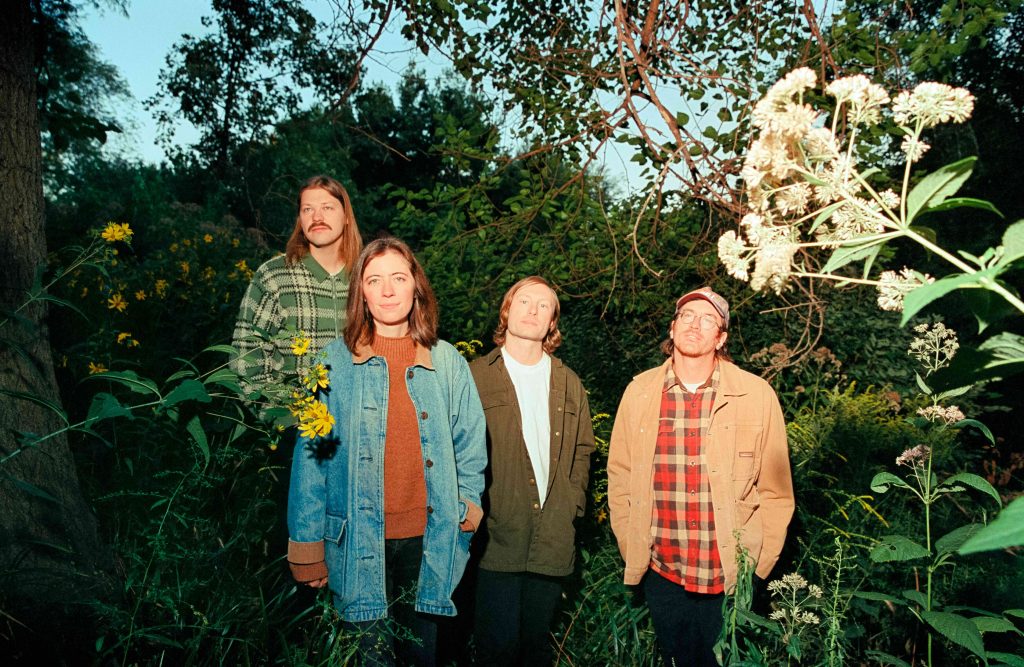
The nicest indie rock band in Chicago has finally uncorked its true sound—it only took 16 years. We catch up with the humble, hard-working Ratboys and talk about swinging for the fences with their new album, Singin’ to an Empty Chair.
Before I can even touch the doorbell, I’m ushered into the warmth of the Ratboys compound, a brick workers cottage from the turn of the century that guitarist Dave Sagan rents with a couple friends and his partner, Julia Steiner, the band’s lead singer and guitarist.
Around the perimeter of the living room, all four members of Ratboys are sprawled on sofas and lounge chairs watching Pluto TV’s free Vevo channels, a nonstop rotation of music videos not unlike MTV’s heyday. From their cushioned islands, they greet me like the close friend who gets a spare key. “You just missed this great Billy Joel live video,” says Steiner. She walks to the kitchen to pour me a glass of water while attempting to relay the piano man’s charm. She watched his new docuseries, she explains, and underestimated his sinuous life story. “You gotta admire how he’s been at it so long.”
Bassist Sean Neumann and drummer Marcus Nuccio lead the way to Ratboys’ longtime basement-turned-practice space, a surprisingly bright room sprouting with gear, a desktop listening area, and a red metallic bunk bed. They’ve been using the space in Chicago’s Montclare neighborhood for eight years, and the memorabilia has piled up: a hasty doodle of Shrek, a banner of Squidward gazing out the Krusty Krab service window. But it’s also a time capsule of the band’s even longer career: a three-foot-long, handwritten guitar tab for “Go Outside”; a 2022 X-ray of Sagan’s elbow, broken while touring in Scandinavia; and Steiner’s first-ever amp, a small Roland Microcube that she still busts out.
Ratboys have been making music since 2010, a lifetime in indie rock years. Steiner met Sagan at college in Indiana, where they immediately started writing songs on an old Yamaha nylon-string guitar passed down from her mother; a few months later, the duo tracked the first Ratboys record. After graduating, Steiner and Sagan moved their small operation to Chicago and assembled full-band touring lineups for each album, even if certain members couldn’t promise they’d stick around. (For their 10th anniversary, Ratboys published a zine documenting their 10 drummers over the years, including Nnamdï and Dowsing’s Mikey Crotty.) Ratboys’ longevity feels casually destined; listening back, an old lyric in “Bugs!” reads like the fateful moment it was decided: “The shaman I saw yesterday told me simply, ‘Go.’”
Sixteen years in, Ratboys have passed the usual breakup window for bands with members in their 30s. They can’t live off band profits, they’ve never gotten a big break, they didn’t record with a formal producer until just recently—and there’s no bitterness about any of it. That’s the upside of hearts uncorroded by entitlement or a major label’s promise of fame. Around here, Ratboys are known among local bands and stagehands for their Midwestern kindness and good humor, with calloused hands from doing the work. “Nothing is guaranteed in this,” says Nuccio. “That’s like rule number one: Rock’n’roll doesn’t owe you fucking shit. But anything you can do to stay consistent and grateful, I think that’s a winning combo.”
Not only did Ratboys never contemplate breaking up, but the period in which bands with day jobs typically do so—10 to 12 years after forming—was actually a window of rejuvenation. Less than two weeks after releasing Printer’s Devil, the COVID-19 lockdown began; the barely used tour backdrop still hangs over a mattress soundproofing their drum kit. But with Nuccio and Neumann officially in the lineup for that LP, Ratboys were hitting their stride and falling in love with being in a band. Trapped indoors, they started a Patreon and a Discord, filmed a livestream series, and rerecorded songs from their debut EP for the celebratory Happy Birthday, Ratboy. “We kept things going in a way that allowed the momentum to build into doing The Window,” says Steiner, “and then luckily that momentum never really stopped coming.”
That pent-up energy comes to a head on Singin’ to an Empty Chair, their sixth and best album. These songs have the clarified rush of an emotional pressure change, like the sensation of removing foam earplugs. The first time I spun Empty Chair, I was struck by how strongly their songwriting reminded me of Death Cab for Cutie’s ambitious pivot Narrow Stairs: “Light Night Mountains All That” revels in a cacophonous layering process like “Bixby Canyon Bridge,” the jaunty bass introducing “Anywhere” satirizes its lyrics like how “No Sunlight” does, and the ominous progression of “Burn It Down” is the vexed older sibling of “I Will Possess Your Heart.” Maybe it’s the dreamlike vocal harmonies between Steiner and Neumann, the freeform guitar solos from Sagan, or the animated prance of Nuccio’s drums, but across all 11 songs, Empty Chair sounds like Ratboys finally reaching the truest version of their sound.
To hash out the demos that would become Empty Chair, Ratboys booked a cabin in Richland Center, Wisconsin, in 2024. They tussled with ideas and half-formed songs until finalizing the arrangements, the most divergent of which was the audacious lead single, “Light Night Mountains All That.” After over six hours playing the song nonstop, they’d created a batch of sprawling tendrils they couldn’t figure out how to bottle up. Overwhelmed, they started yelling at each other, frustrated and excited to capture the song’s potential. “We looked schizophrenic,” laughs Nuccio. “This song felt crazy, but there was something intriguing about it, so we took a day to fully go down the wormhole, mapping it out on papers, figuring out the time change.”
They brought the demos back to Chris Walla, the former Death Cab for Cutie guitarist who’s now a coveted producer, to help find their way out of the maze. On Ratboys’ previous album, The Window, Walla’s attentive and intuitive methods allowed the band to chisel away at its sound to uncover new dimensions. The producer’s greatest strength, according to the band, is how he locates the feeling bubbling beneath a song and uncorks its emotional impact. “When writing and demoing songs as the four of us, we’re talking about music theory and chord progressions,” explains Sagan, “but Chris refreshed our views by reaffirming our emotional direction.” So Walla shipped some of his personal recording gear from Norway, packed two enormous suitcases, and flew to Chicago promising to help Ratboys capture the Empty Chair they really wanted.
At the urging of Walla, who admired how spacious their demos sounded under the high ceilings, Ratboys returned to the Wisconsin cabin in February 2025. The five of them pushed the furniture out of the living room, loaded in their gear, and settled in for a week of living together while Walla recorded their songs to tape. With no neighbors for miles, Ratboys let it rip. At the time, Sagan was getting antsy to perform live again; Neumann was grieving his dog, who’d just died; Nuccio’s full-time job was downgraded to a freelance position, then evaporated entirely; and Steiner had begun seeing a therapist, seeking support amid her parents’ recent divorce and cracks surfacing in her family life. The simple rhythm of those Wisconsin days—cooking meals together, fleshing out songs, rattling the windows during rehearsals, watching Kids in the Hall to wind down—became an emotional reset.
Committed to emphasizing live takes, Ratboys learned to appreciate the imperfections in these recordings. A gust of wind howls in the background of “Strange Love,” a demure song fit for an old-timey diner, and makes Steiner and Neumann’s harmonized coos even fuzzier. Instead of waiting for the perfect take, they started pursuing fleeting ideas in the moment. After recording “Penny in the Lake” nearly 18 times, it was the first recording of day six—in which Nuccio impersonates a rooster greeting the sunrise—that finally rolled its shoulders back and nailed the lackadaisical twang.
The real magic of Empty Chair was captured at Electrical Audio, the late Steve Albini’s studio back in Chicago. Neither Ratboys nor Walla had stepped foot in its hallowed halls before, so they gorged on its offerings: booking time in both studios A and B, jamming extensively to see where loose ideas concluded, working giddily with engineer Taylor Hales. Ratboys planned to record a plump bass note on a synthesizer or a guitar pedal for the intro of “Open Up,” but Walla and Hales brainstormed an alternative method: drag a dozen snare drums into the room and mic them rattling after a bass note instead.
“Using equipment that wasn’t an instrument in a musical way was so fun and inspiring,” says Sagan. “Each song has a little element of sound design in addition to its straight-up recording. Maybe we’re the only ones who can notice it, but it helped us get the feeling we wanted.” A damaged pocket piano doubles as a shaker in “Light Night Mountains All That,” a wireless radio revolving on a turntable creates a Doppler effect in “What’s Right?”, and a microphone spins around the room like a lasso to record an acoustic guitar in “Burn It Down.” Sagan used the ominously labeled “hell guitar” at Electrical Audio—a 16-string guitar with every string tuned to the same note—to pepper chaotic, loud strums into “Light Night Mountains All That,” which were then reversed and treated.
Ratboys sound youthful and raw, like they placed themselves in the moment while tracking each song. A large chunk of that spiritedness rests on the rhythm section, where Neumann steadily adds a flair and Nuccio picks up the pace behind his kit. While there’s a little studio trickery, like a drum part taped at a slower tempo but sped up to the BPM in the recording, the rest was due to a perspective shift. “For a couple years in indie rock now, there’s been a trend of very dry, dead, low-tuned drums that are quiet and muted,” says Nuccio. “Chris [Walla] saw that and said, ‘Let’s be honest to our pop-punk roots.’ So we did some unique drum treatments, like replacing the heads on the drum set, which were thin and clear, with these thick and coated heads that give it a snap, a lively sound. Motown is the same way.”
Before you can get the perfect take, you have to be able to lock in, and Ratboys are quick to credit Walla as an observant producer who recognizes the parameters of each member’s comfort zone and helps them recreate it. Whenever Steiner entered the vocal booth, Walla noticed she would grab an object, usually a wheel of gaff tape, and fidget with it while singing. Rather than joke about it, he encouraged her to use it as a resource. “He was so perceptive and supportive,” recalls Steiner. “Eventually, when it was time to do a vocal take, Chris wouldn’t even say anything. He would just hand me the roll of tape, like, Off you go.”
Over email, Walla gushes about his time working with Ratboys. “Some [bands] are fractured and tormented and ultimately unsustainable, and the discord fuels the work until it doesn’t,” he explains. “Some are blissful and lucky and just happy to be there. Ratboys work because they work. Dave and Julia’s chemistry has a perpetual-motion-machine quality to it, and Julia also knows how to lead a band; she’s so clear and consistent, and she’s always got the goods. And holy cow she’s leading a great band.””
When we resurface outside, we’re thrust into Chicago winter: fluffy snow banks covering the grass, sidewalks slicked in ice, sharp wind redistributing the topmost layer of snowflakes back into the air. We shuffle past Ratboys’ shiny, newly purchased used camper van—its blinker needs fixing—and toward a well-worn SUV covered in snow. Sagan brushes off the windows and we all squeeze in. On the drive, they trade stories like tour guides, pointing out a neighborhood allegedly run by the Italian mob, a graffitied bridge in the woods where they smoke like high schoolers. In a city with two notoriously ill-fated baseball teams, Ratboys are split down the middle: two Sox fans, two Cubs fans.
We arrive at our destination: Gene & Jude’s. The old-school sign glowing atop the building beckons us inside, like some insignia of fast food proselytization. Built in 1950, the retro hotdog joint is the epitome of no-frills: Depression dogs and French fries, with toppings limited to mustard, relish, onions, and sport peppers. No ketchup; no seats. We eat standing up at the wraparound counter and revive our sports convo as a crew of construction workers ambles inside. Apart from her lifelong patronage of the Steelers, Steiner explains, she and her bandmates are Chicago-pilled through and through: Bears, Bulls, Blackhawks. As we talk at length about the Sox, it becomes clear they love the team not despite its foibles or financial pitfalls, but because it can’t help but carry on. You can love a losing team knowing there’s always next year, or you can be glad they’re here hustling in the present.
We relocate to Hala Kahiki Lounge, a sprawling tiki bar down the street that’s over 60 years old, and Steiner opens up about some of the wounds she nursed while writing this record. For the past several years, she’s been struggling to process the sudden estrangement of an unnamed relative. She attended therapy, a first in her life despite growing up with a psychiatrist father, and found the experience “revelatory”—particularly when her therapist suggested she try the empty chair technique. The premise is straightforward: find a private space, sit down, and talk to an empty chair opposite you while envisioning the person with whom you’d like to have an honest conversation. Back in her bedroom, Steiner blocked out time on her calendar, hit record on a voice memo, and started talking. What spooled out was a frank confession of hurts, cherished memories, and moments when she’d sought clarity. “Listening back, I had this appreciation for the past while also not excusing any transgressions that have happened, and was hoping for possible reconciliation,” says Steiner.
That’s the roadmap that would inspire Empty Chair. It begins with “Open Up,” in which a calm Steiner encourages someone to resume a long-paused conversation. “I won’t go,” she sings softly. “I’m listening.” It’s the most work Ratboys have poured into seeing their ideas through, and the epiphanies—and equally memorable regrets—match the mood of a weight being lifted. Memories flash by in rapid succession in “Just Want You to Know the Truth,” where Steiner lays her heart bare for her estranged relative: “It’s not that I don’t miss you/Or the way it used to be/It’s that I can’t live my life/Without sayin’ anything.”
Unless her future self thwarts the plan, Steiner will mail a copy of Empty Chair to her estranged relative in hopes of reconciliation. “It feels a little bit strange to admit this, but part of this record, for me, was a bit utilitarian, almost like a communication tool,” she says. “Maybe this is taking the easy way out, but having the opportunity to send it as an olive branch is a way to talk without talking.” Steiner takes a deep breath, flushed with nerves and a dash of guilt, and looks around the table at her bandmates. “I’m grateful that y’all were patient enough with me to let it happen naturally, because it took a long time.”
Steiner’s bandmates rush to reassure her that it was never a question, that it was more than worth it; it’s a centerpiece of Empty Chair and their long journey of Ratboys overall. For the next half an hour, they share their favorite memories from the album sessions: Sagan’s timeless guitar solos, Steiner’s idea for the tracklist, Neumann’s smooth vocal harmonies, Nuccio’s creative use of synth. On Empty Chair, it all comes together to leave the lasting impression that everything will work out if you surround yourself with loved ones. “That building of trust has always been strengthening, and that helps our anxious minds know that it’s going to be okay,” says Neumann.
As we pile back into Ratboys’ SUV and Sagan once again clears snow from its windshield, Steiner turns the radio to their favorite station, an oldies channel that plays only music recorded prior to 1970, with one exception: Cher’s “Believe” on Saturday nights. The conversation turns to the Bears, who play the Rams this weekend following their first NFL playoff win in 15 years. They haven’t looked this good in a long, long time. The air in Chicago is charged with a belief that anything can happen. Some would advise against that kind of hope, especially for a sports fan, but why deny yourself the possibility of a dream fulfilled? It’s one of the best feelings in the world.