Interpol Looks in the Mirror and Wonders, Who’s Looking Back?
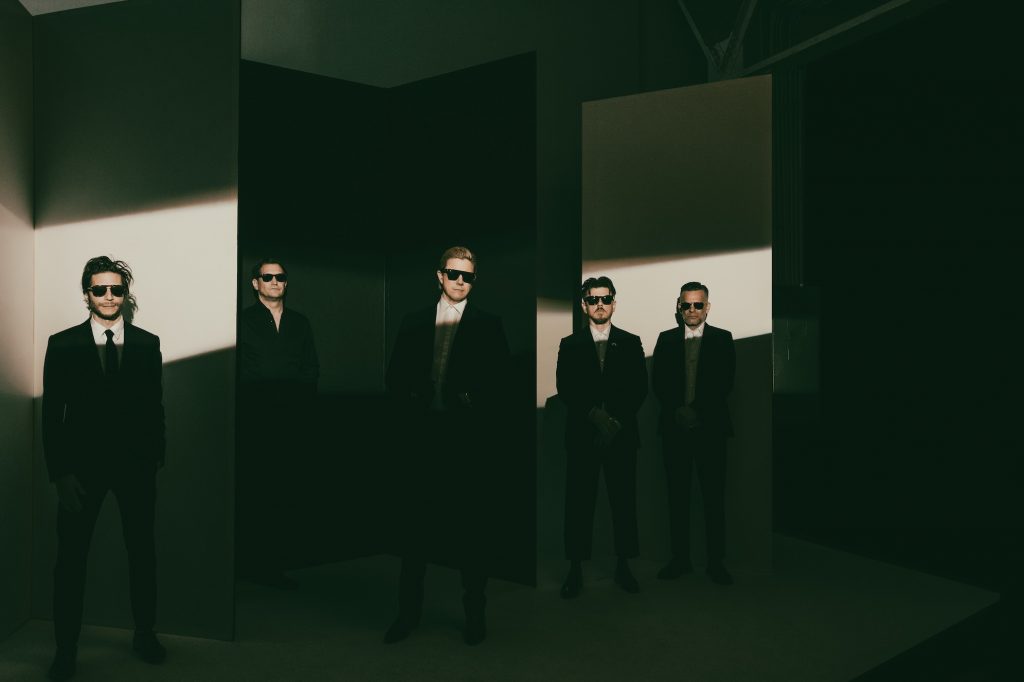
The band that emerged in post-9/11 New York grapples with the surveillance state on its anxious but hopeful new LP, “This Mirror Weighs a Ton.”
By Mike Isaac
For a band that has for so long embraced a core identity of being from New York, some of the ways the city has embraced Interpol could be considered accidental.
Its widely acclaimed first album, “Turn On the Bright Lights,” was written long before the Sept. 11 attacks that toppled the World Trade Center, traumatized the city, launched foreign wars and led to an era of domestic surveillance. And yet after the record’s 2002 release, it came to define the collective mood: 49 minutes of post-punk brooding and melancholy drone that delivered an almost mournful love letter to a wounded populace.
“You’re reflecting a moment in time, you know what I mean?” Paul Banks, Interpol’s 48-year-old frontman, said in an interview over a pier-side lunch on the San Francisco Bay. Earlier this month, the group performed a three-night run of shows there in the middle of its North American tour. Between bites of Peruvian ceviche, Banks noted how sometimes a work of art arrives just as people are searching for it. “Hopefully, as an artist, you’ve got some insight into the pulse of what’s going on around you, even if you might not have articulated that directly,” Banks said.
Nearly 25 years and seven studio albums later, Interpol has come full circle. America is again at war abroad and the surveillance state stretches even further into American life. But in “This Mirror Weighs a Ton,” the band’s new LP, out Friday, Interpol grapples with those matters directly. It is the first album the group recorded in New York City in over a decade.
The album touches on the steady drumbeat of technological advancements and ideas of “progress” that can feel increasingly isolating. The cover art is even less subtle: a chandelier made of 14 closed-circuit cameras — the kind you might find above a bank teller’s head — pointed in all directions. (The piece, “Asymmetric Love Number 2” by the New York artist Addie Wagenknecht, is part of the permanent collection at the Whitney.)
And while “Mirror” brings a familiar mix of Interpol’s tinny riffs, shifting tonal signatures and distorted, abrasive chords, it is buttressed with experimentation. There are warm, swirling synths, a woodwinds section, even the gentle chirping of birdsong in Central Park.
“I think we are an evolving band, but we’ve done so through a kind of process of continuous arrival,” said Daniel Kessler, 51, Interpol’s lead guitarist, who showed up to lunch dressed in black slacks, oxford collared button-down and a flowing trench, the only pops of color showing when he crossed his legs to reveal blood-red socks. “All of our records are emotional, but in this record certainly there’s hope and playfulness along with the heaviness.”
For all of the band’s New York-ness, most members of Interpol migrated to the city. Kessler was born in England and grew up in France before studying at N.Y.U., where he connected with Carlos Dengler. They recruited Banks — who was born in England, raised in Mexico and Spain — after meeting at a study abroad program in Paris. After another drummer’s departure, Kessler asked Sam Fogarino, a Philadelphian nearly a decade his senior, to join the band in 2000.
By 2001, Interpol was grinding it out playing cramped, sweaty rock clubs on the Lower East Side. With MTV awash in alt-metal’s wide jeans and backward New Era caps, the band members opted for French New Wave mod vibes and a sunglasses-at-night look worthy of Jean-Luc Godard.
“Turn On the Bright Lights,” the band’s first full-length album, landed the next year amid a New York City in transition. The album’s gloom became a backdrop to critiquing Bush-era foreign policy, post-Patriot Act domestic surveillance and a series of foreign wars much of the nation would come to regret. On “Obstacle 1,” the breakout single, Kessler’s repetitive guitar picking took on the cadence of a blaring alarm. Dengler, who went by the stage name Carlos D, played dynamic bass lines and wore holsters on his belt. (He ditched pistols for packs of cigarettes.) Fogarino’s rollicking drums brought a verve that cut against Banks’s stark baritone, a voice that critics regularly compared to Ian Curtis of Joy Division.
Interpol shared rehearsal space with bands that would come to define the scene: TV on the Radio, Animal Collective, Lightning Bolt. The Yeah Yeah Yeahs regularly played the Mercury Lounge on Houston Street, while the Strokes were fast earning a reputation for being the raucous boys of Lower Manhattan. Audiences began to consider rock synonymous with New York instead of Seattle or Los Angeles.
“Bands were sprouting up everywhere,” said Amedeo Pace, a friend of Kessler and member of Blonde Redhead, a New York noise rock band that was one of Interpol’s contemporaries. “The music scene was interesting and alive, and the city felt open-ended with no clear boundaries.”
Interpol followed up with 2004’s “Antics,” building on the moodiness of “Lights,” and two more LPs that decade that turned sharply into a grandiosity of sound that divided fans but pushed boundaries. The 2010s saw Interpol hit its rockiest personal patch, after a decade of relentless touring. Banks, who embodied the booze-and-drugs rock star lifestyle, hit a bottom. Dengler clashed with other members over creative differences, leading to his departure. There were serious questions as to whether Interpol would break up.