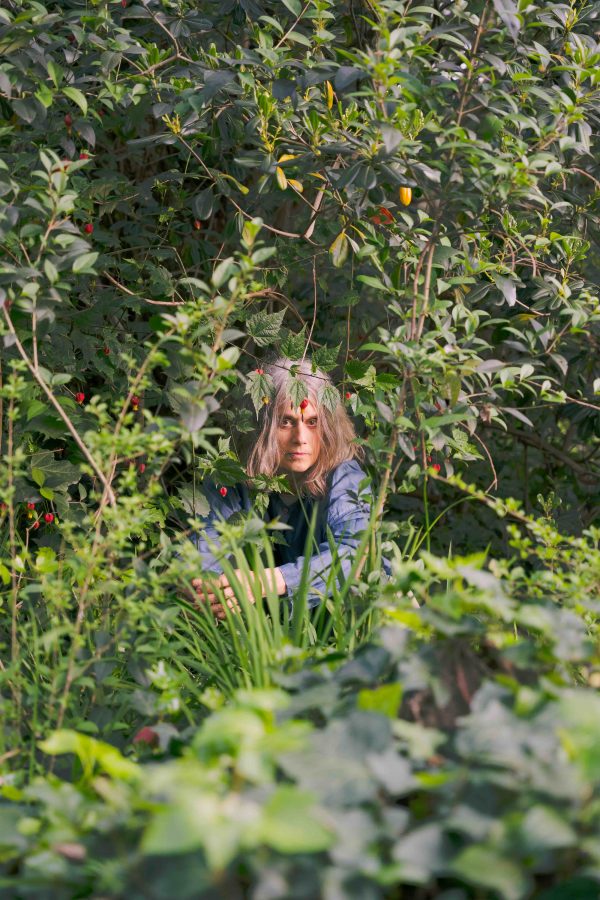
Juana Molina
Biography
Born in Argentina, Juana Molina grew up in a deeply musical environment. Her father, the renowned tango singer and composer Horacio Molina, taught her guitar from the age of five, while her mother, the actress Chunchuna Villafañe, introduced her to a vast and diverse family record collection that shaped her artistic sensibility from an early age.
After the 1976 military coup, the family went into exile and lived in Paris for six years. That French adolescence broadened her musical universe: Juana spent hours listening to radio stations that programmed music from all over the world, an experience that would forever shape her ear and her sonic imagination. Upon returning to Argentina, she decided to become independent and pursue a career in music, but first ended up making her way in television. After an audition for La noticia rebelde, she was hired immediately and, a few years later, her own program, Juana y sus hermanas, made her the most popular comedian in the country. At the peak of her fame, however, she chose to leave acting behind and return to her original calling: music.
That radical turn was not without challenges. Her first album, Rara (1996), produced by Gustavo Santaolalla, was met with bewilderment: audiences expected comedy, and the press kept asking whether she would eventually return to television. But Juana persevered. With Segundo (2000) and Tres Cosas (2002), international recognition began, first in Japan – where she toured for the first time in 2002 – and later throughout the rest of the world, through her signing to the prestigious Domino Records label in 2003. Tres Cosas was chosen among the ten best albums of the year by The New York Times, and her musical universe – an inimitable blend of folk, electronics, loops, experimental textures, and intimate melodies – made her a favorite of figures such as David Byrne, with whom she toured across the United States in 2004, becoming the first Argentine artist to perform at the Coachella festival.
Critics around the world celebrated her singularity: “pure genius” (Les Inrockuptibles), “captivating” (Pitchfork), “one of the most extraordinary voices of the moment” (Sunday Times), “creator of a soundtrack for the subconscious” (Spin), and “the maker of a subtle and unclassifiable sonic magic” (Uncut). As The New York Times summed it up: “Molina imitates no one; she is having too much fun being herself.”
In the following years she released Son (2006) and Un Día (2008), touring extensively throughout Europe, the United States, and Japan with hypnotic performances built solely around guitar, keyboards, and her inseparable loop station.
In 2013 Juana released Wed 21, an album with a more electric, rock-driven pulse that was also consolidated live with the trio she formed with Odín Schwartz and Diego López de Arcaute, her drummer since 2010. That energy would become the foundation for Halo (2017), recorded in part at Sonic Ranch in Texas and met with unanimous acclaim that reaffirmed the maturity and singularity of her musical language.
After Halo, a period of transformation began. Her concerts shifted toward improvisation, analog loops, and experimental sessions. In 2021, together with her manager Mario Agustín de Jesús González, she founded Sonamos, an independent label conceived to care for and release her work – and that of other artists – with complete creative autonomy and carefully produced editions.
The label’s first release was the 21st-anniversary reissue of the landmark Segundo, remastered and accompanied by a substantial 16-page booklet with photos and texts. The international press celebrated the edition: Mojo awarded it four out of five stars, highlighting its “loving yet rigorous remastering,” while Uncut gave it a nine out of ten, underscoring its continued sonic relevance. The Vinyl District included it among the 100 best reissues of 2021.
The label continued to expand its catalog with the reissue of the mythical Musicasión 4 ½ (1971), a key work of Uruguayan candombe-beat. The new edition – produced from previously unreleased tapes found by González – had a major regional and international impact. Paste Magazine included it among the 20 best reissues of 2022, emphasizing its historical value and sonic restoration, and Sounds and Colours selected it among the “Best Compilations & Reissues of 2022,” celebrating it as “a rare gem rescued from oblivion.”
Meanwhile, Juana continued creating new music outside the pressure of schedules and expectations. The seeds of a new project began to sprout in 2019 during improvised sessions with Odín Schwartz, and in 2022 they took concrete shape over long days at Sonorámica studio in Córdoba (Argentina). That process culminated in 2025 with Doga, her first studio album since Halo, produced together with Emilio Haro.
Released on November 5, 2025 by Sonamos, Doga brings together ten songs that reveal a luminous maturity: an expansive synthesis of folk-pop, electronic experimentation, and the enigmatic aesthetic that characterizes all of her work. Its advance single, “Siestas Ahí,” pointed in that direction with evocative textures and a subtle balance between the melodic and the abstract.
Since its release, Doga has received immediate and sustained attention from the specialized press, both internationally and locally. The interest was due not only to the recording hiatus separating Doga from Halo, but also to the way the new work consolidates and expands a singular artistic language: deeply personal and far removed from trends.
One of the first outlets to review the album was Pitchfork, which gave Doga a rating of 8.1 out of 10. The review described the album as a “strangely unsettling” collection in which barely suggested melodies coexist with ghostly electronics and lyrics that move between the playful and the existential. According to the American publication, the songs function less as conventional pop pieces and more as soundscapes or narrative riddles, underscoring the album’s coherence as a work that privileges sensory exploration over immediate impact.
The prestigious British magazine Uncut also received the record very positively, rating it 9 out of 10. In its review, it emphasized Juana Molina’s ability to build hypnotic atmospheres from minimal resources and highlighted Doga as a work of “strange beauty and deep internal cohesion.” Uncut noted that the album reaffirms Molina as an artist “outside of time,” distant from the urgencies of the market and faithful to her own creative logic.
Rolling Stone included Doga among the 50 best Latin albums of 2025, placing it at number seven. There, Juana Molina is described as “one of the most intriguing artists in Latin America,” and her music as “mysterious soundscapes” – a direct reference to the expansive and experimental style of Doga.
In Spain, the website Jenesaispop rated Doga 7.6 out of 10, noting that the album confirms Juana Molina as a “tremendously unique” creator, even within her own discography.
The Argentine press accompanied the release with enthusiasm and depth. Página/12 published an extensive piece describing Doga as an unpredictable and playful album, traversed by absolute creative freedom and an explicit will to avoid repeated formulas. The newspaper emphasized that, far from seeking a nostalgic reconciliation with earlier stages, Molina here affirms herself as an artist who continues to take risks and embrace constant transformation.
In a similar register, the Argentine outlet Indie Hoy chose the album as the best album of 2025.
Juana’s live performances during this new stage were read by the press as a direct extension – and in many respects, a deepening – of the universe proposed by Doga. Far from functioning as a simple reproduction of the studio songs, the concerts were described as spaces of constant mutation, where the compositions expand, deform, and acquire new layers through the use of loops, analog synthesizers, and open structures.
Several outlets agreed that Doga finds its fullest form on stage, emphasizing that Molina does not offer a frontal or narrative show, but rather an experience in which time seems to dilate and the audience’s attention is absorbed by small sonic shifts.
In Argentine media such as Página/12, reviews emphasized the coherence between Doga’s experimental spirit and its translation to the stage. According to the newspaper, Molina appears on stage as a composer who “listens” as much as she performs: attentive to accidents, productive errors, and minimal variations that can alter the course of a piece. That attitude – closer to controlled improvisation than to closed execution – was singled out as one of the most distinctive traits of the concert cycle.
For the newspaper Clarín, the Doga concerts represent something more than a promotional tour: they are a reaffirmation of Juana Molina’s status as an avant-garde artist in Argentine music, capable of transforming her records into immersive experiences. The newspaper highlights the ritual quality of the show, its fidelity to an experimental aesthetic, and its ability to bring together a diverse audience – young listeners, longtime fans, and alternative-music audiences – in a context that is intimate and expansive at the same time. As a result, the review values the concert not only for its execution, but also for its symbolic dimension: that of an artistic return with an identity of its own.
Today, with Doga newly released, Sonamos fully active, a series of carefully produced reissues, and an international schedule in constant motion, Juana Molina reaffirms her status as an autonomous creator. She is an artist who redefines her history with every step, who protects her legacy while expanding it, and who continues, tirelessly, to explore new sonic territories.
SONAMOS Presents DOGA
Juana Molina’s eighth long play and her first album of new compositions in eight years.
An album that took almost six years to cook. It was like preparing a meal for six guests with ingredients enough for a battalion. The overwhelming amount of recordings paralyzed Juana, who at one point came to think there was nothing with which to make an album.
“Whenever I finish making an album, there is an inertia that makes me keep recording,” but we could place the beginning of the composition and recording process for this brand-new work in 2019, during the preparation of a series of concerts called Improviset, which Juana performed with multi-instrumentalist Odín Schwartz.
“The idea was to play as if I were at home – that is, to improvise,” Juana explains. “It was mainly a duo of analog synthesizers and sequencers. We recorded everything, many, many hours, because there was no way to repeat what we were doing; both rehearsals and shows were unique. Some of those ideas were later revisited.”
When the world pulled down the shutters because of the pandemic, Juana was finishing her performance on the stage of Festival NRMAL in Mexico City, on March 6, 2020. That Mexican performance became her first live album: ANRMAL (RGS/Crammed, 2020), a superb live document with a repertoire based on Wed 21 (2013), Halo (2017), and the reworkings EP Forfun (2019).
The end of the pandemic brought developments in several directions: together with her producer and current manager Mario Agustín de Jesús González (aka Marito), Juana founded the label Sonamos, through which, among other releases, the magnificent anniversary reissues of Musicasión 4 ½ (1971, the foundational album of candombe-beat) and Segundo (2000, a key work in the artist’s own discography) appeared. She also returned to performing in various formats – solo set, Improviset with Odín Schwartz, and duo with drummer Diego López de Arcaute – in the United States, Europe, and Asia, and severed contractual ties with the record companies that had until then released her work in various regions of the planet. In this way, Juana became an artist exclusive to herself.
Meanwhile, the new material kept beating, and in the spring of 2022 she booked ten days at Sonorámica studio in Traslasierra, Córdoba. “We took a preselection of the Improviset recordings with us, and there the ideas for new songs appeared more clearly,” she comments.
Taking advantage of the momentum from Córdoba, her home studio in the Buenos Aires suburbs became the refuge for new and marathon-length sessions. Thus she arrived in mid-2024 with five songs already outlined and an ocean of recordings into which she had to dive and try to resurface with an album.
“After Sonorámica I spent two more years composing; I felt I had nothing. Until one day Marito started organizing what was there and we saw that we had reached 30 hours of ideas. That sparked enthusiasm and, at the same time, paralyzed me because I had to decide what direction to take, since there were very dissimilar things. We even fantasized about making a triple album, one of them instrumental.”
At the beginning of 2024, Mario proposed finishing the work with an outside producer, someone with fresh ears for the new material. In that context Emilio Haro appeared, already familiar to the house through his work as producer of Carolo’s debut LP, released by Sonamos in 2023.
Emilio Haro joined the process in its final stage, but his imprint was perhaps decisive: “He was very excited from the start, and I could say he got more out of me than anyone before,” Juana concludes. “I would record a guitar and he would tell me to record more, with another sound, another arrangement, another idea. Then he would take the recordings and program things on his own, many of which stayed on the album. I like the overall criterion he has for the songs, the aesthetic of the mixes. I am more rough-and-ready; I do not usually use post-recording effects, and I felt Emilio had great command when it came to generating spaces around things.”
Made up of 10 grooves spread across four sides of double vinyl at 45 rpm, with its polysemic title, extraordinary cover art by Alejandro Ros, and proudly produced entirely by Sonamos, DOGA automatically takes its place in that unique space in popular music occupied by Juana Molina’s records.
The album concentrates all the qualities that distinguish Juana Molina’s music and takes one step further in the ongoing search for the singular: where no influences can be detected, the genuinely original, that which – literally – resembles nothing else. Unexpected melodies, ethereal and organic sounds, the minimal and subtle gesture, repetition as an aesthetic, austere and seemingly static harmony, lyrics as concentric layers: a familiar yet always surprising landscape for the artist’s usual audience and an unbeatable gateway for newcomers to the planet of Juana Molina.