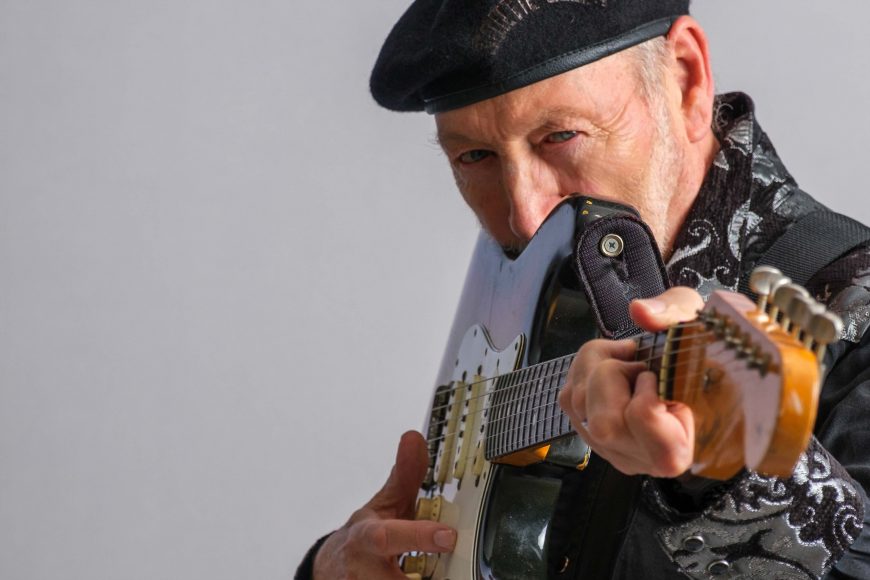
Richard Thompson
Biography
Hippies, Thugs, and Heroes
“One of the nicest things about creating something is surprise,” says Richard Thompson of his twentieth studio album, Hippies, Thugs and Heroes. If you step aside, your inner strangeness jumps to the forefront for a while, and it’s truly bizarre what can come out of your subconscious. I’ll write something and then a day later, or even a year later, I’ll look back at it and think, What is this thing? Where did it come from?” In this case, it was a motley cast of characters: old friends and false gurus, beloved musicians and former selves, hippies, thugs, and heroes—some true to life and others dreamed up wholecloth. They all climbed out of some deep recess of his mind and insisted he tell their stories. “There isn’t a song on this record that I’m not surprised by or that I fully understand, and I’ll take that as a good thing.”
Sixty-odd years into his career, first as a member of the legendary folk-rock troupe Fairport Convention and then as a solo artist, Thompson still manages to find room in his writing for such happy accidents and subconscious connections. These new songs surprised him with their characters and their ideas and most of all by coalescing into a kind of spiritual inquiry: a catalog of the things that distract us from living our fullest lives. “Build your dreams and towers to the sky, all to dust and ruin in the blinking of an eye,” he cautions on “She’s Burns It All,” whose pendulum guitar motif and moaned vocals recall the Incredible String Band and other fringe folk revival acts. As Thompson explains, “This song grew into itself organically, as though it didn’t need me. Whatever you construct in your life, if you invest in it totally, it’s only going to disappoint you. You have to have a spiritual overview.”
Hippies, Thugs and Heroes never settles into one style or mood or setting, but shows so many different sides of Thompson as a songwriter, singer, guitarist, and bandleader. It has its own spiritual overview, as he moves gracefully from the bright, Byrdsy opener “The Sorcerer’s Apprentice” to the rowdy, rootsy “Everybody’s Stealing” to the bluesy closer “Stringer.” Thompson strove to let each song discern its own course. “They all cropped up individually. You might think. Oh, this’ll only be an acoustic song. Or, this will work well with the band. But they lead you down certain paths to certain conclusions—sometimes not the conclusions you were expecting. But that’s the joy of songwriting. You don’t always know where you’re going.”
Thompson wrote and demo’ed songs for his backing band, which includes Taras Prodaniuk on bass, Michael Jerome on drums, David Mansfield on guitar and fiddle, and his wife Zara Phillips as a backing vocalist. Because he had a little more time on his hands, his home recordings were much more elaborate, much more specific. “It’s so much fun to mess around at home and disappear down in the basement for hours at a time. I even bought myself a drumkit. So I was able to present more complete demos to the band. You could say there’s much more of my identity being transferred to the final product.” As always, he left room for the band to add their own ideas, but admits Hippies, Thugs and Heroes is “less them and more me. But I’m never strict about what I want to hear on a record. I’m always interested to see what they come up with, and I always want to see where the song takes me.”
With its chiming 12-string riff and insistent backbeat, opener “The Sorcerer’s Apprentice” took Thompson back to his own past. “In the 1970s there was a lot of spiritual searching going on, and I was involved with a particular group where the leader got too big for his spats, so to speak. It’s a very complicated relationship, and you can get sucked into people’s way of thinking. So it can be a great relief to finally say, I’m sorry but you’re way off message. We had three electric 12-strings competing with each other, which really seemed to fit that idea.”
Thompson and the band convened at Hobosound Studio in Weehawken, New Jersey, conveniently located a stone’s throw from his own home. “It’s very easy to call up David and say, Are you busy? Do you want to play? I think that’s why this album came together so quickly. We could just steam through at high speed and not labor over everything.” The small crew recorded live with a minimum of takes—sometimes as few as two, but rarely more than four;. That approach lends the songs a grittiness as well as a sense of urgency, especially “Cocaine Walking, Booze Talking.” It’s a hardscrabble tale of folks hustling in London—a “carousel queen” overwhelmed by the big city, a soldier quoting Shakespeare, “a Kings Road Hippie,” and a “Sauchiehill thug.”
All of those strivers and connivers seemed to belong together in one song, but initially Thompson wasn’t sure exactly why. “They’re a conflation of a few people I knew, and they’re all Scots who came down to London to work. There was this pattern among them, where everything went sideways for them. They’re all different, but they overlap as human beings. People always reveal themselves in extreme situations. If everything’s nice and everybody’s happy, there’s not much to write about.”
“Cocaine Walking” also features some of Thompson’s most subtly inventive guitar playing: a series of strutting, raw-nerve riffs culminating in a splintered and psychedelic solo. As with songwriting, he doesn’t force his solos but tries to let them come naturally; he wants to be surprised by what he plays. “You practice possibilities, and then you try to expand those possibilities. You try to develop a wider and wider vocabulary as you go through life, because that’s what you draw on when you’re improvising on a song like ‘Cocaine Walking’ or ‘The Sorcerer’s Apprentice.’ It can lead you to places that you’ve never been before. Oh, I never realized I could go from that to this.”
As Thompson finished recording, he found that all of these disparate songs and desperate characters formed an album that is both coherent and daring, familiar yet new: a feat of songwriting and storytelling. “You look over the body of songs you’ve written and ask yourself, Which ones are kindred spirits? You look for commonality among the songs, and it’s also a joy when you realize that certain songs seem to be brothers and sisters. Songs are like children. They grow up and have their own lives, but you have this continuing relationship with them. I’ve got some old songs that I’ve been singing for nigh on 60 years, and while I won’t be singing any of these songs in 60 years, it’s good to let them go and see what other surprises they reveal.”
Video & Press
The Indefatigable Richard Thompson Introduces his Hippies, Thugs and Heroes in October
[Americana UK] By Keith Hargreaves Richard Thompson will release his 20th studio album, Hippies, Thugs and Heroes, on October 16th via New West Records. The 12-track set was produced by Thompson and James Frazee and recorded in Weehawken, New Jersey. It follows his previous offering Ship to Shore, which Uncut Magazine named one of the “Best Albums of […]